Julia Borbely-Brown opened last night's Women for Wise Growth forum on the drought with an emphatic "The drought is not over" statement. In the Herald-Sun today (and circulating as well on local email lists) is a letter from Joe Curtis and Sylvia Le Goff (of
Keep Durham Beautiful) saying the same thing.
In both instances, the people saying this are hoping to convince others not to give up on the conservation measures they've been practicing over the past 6 or 8 months, since water supplies in the Triangle dropped perilously low.
After listening to last night's presentations, and monitoring
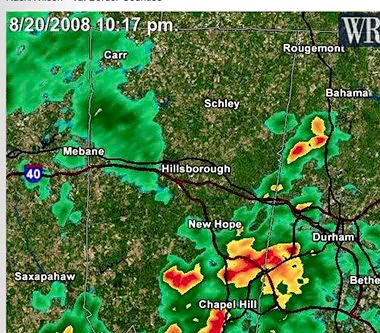
rainfall,
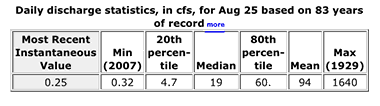
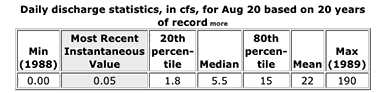
stream flows, and
reservoir elevations for the past 6 months or so, i've reached the conclusion that, regardless of whether or not we're in "a drought," it's simply no longer useful to be discussing our water woes on that basis.
Elaine Chiosso of the
Haw River Assembly spoke at length last night about water quality issues in the Haw basin and Jordan Lake. Most of these issues relate to stormwater runoff, especially nutrient (phosphorus and nitrogen) pollution and sedimentation. This pollution impacts the ability of Jordan Lake to act as the region's buffer against water shortages, and is actually increased by normal rainfall. Barry Jacobs, of the Orange County Board of Commissioners addressed development issues, and more than once referenced the innate carrying capacity of the system as a limiting factor in how much population can be supported.
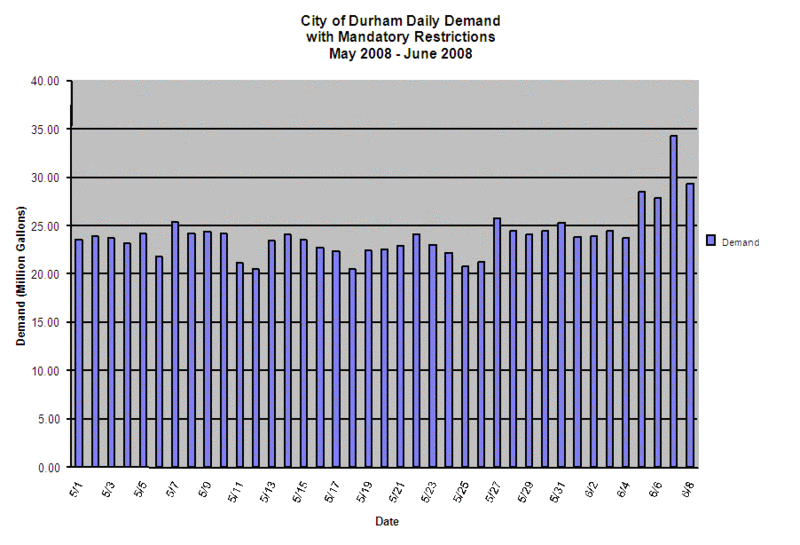
What i realized is that the constant reference to "the drought" leads to a way of thinking, which has found expression in the comments here, at Bull City Rising, in letters to the editor at our local newspapers, emails to elected officials, and private conversations, that once we get adequate rainfall, "the drought" will be over. And i think that as long as we keep referring to our water issues as "drought" related, that kind of thinking will be the logical and appropriate response. What we need to do is start addressing our water issues as a long-term, systemic imbalance between supply and demand which cannot be addressed as an economic problem simply by increasing supply. That's beyond our capability. We can manage our supply better, but how much rainfall we're going to get in any given one, five, or ten year period is not ours to determine. We can also manage our demand a lot better, and that's where the most significant change in our thinking has to come. Stage III and Stage IV water use restrictions are emergency measures designed to respond to a crisis. We need to move beyond those.
Melissa Rooney, a South Durham activist, presented a slide show at the conclusion of last night's forum, showing some pretty abominable development practices, including clearcutting and mass grading. The result of these practices is quite predictable: increased stormwater runoff leading to lower groundwater retention, higher pollution levels, and increased water use by new homeowners trying to "green up" their properties.
It's almost inconceivable that these practices are permitted under Durham's new UDO, but apparently the rules requiring buffers and trees are flexible enough that developers are able to work around them as they see fit. On a smaller scale, i've recently discovered to my dismay, that the UDO similarly contains no provisions dealing with creating impervious surface on existing residential lots. If you want to pave your entire backyard and turn it into a parking lot in Durham, you have the blessings of the city.
The solution to what seems to be becoming a chronic issue of water supply is complex, but most of the answers are available. It's going to require a lot of creative thinking on the part of our elected leadership to get these best practices implemented however. Especially if we continue to have leaders who are more comfortable managing crises, rather than preventing them.
Labels: development, drought, local government
Continue reading Are we still in a "drought"?